
Most modern enterprises operate internationally from day one. Companies hire remote talent across borders, acquire customers across multiple continents, and manage suppliers across diverse regulatory jurisdictions.
However, traditional financial infrastructure has not kept pace with modern commerce.
When digital platforms, e-commerce merchants, and iGaming operators expand globally, traditional corporate banking channels often create operational friction. That means:
To maintain momentum, expanding companies require a flexible financial stack designed for real-time international settlement.
An agile corporate account is more than a passive repository for operating capital. It functions as a financial technology platform that connects corporate treasury systems directly to global clearing rails.
Instead of establishing and managing separate banking relationships in every operational market, an Electronic Money Institution (EMI) like Trumia provides a single gateway to manage multi-currency cash flows worldwide.
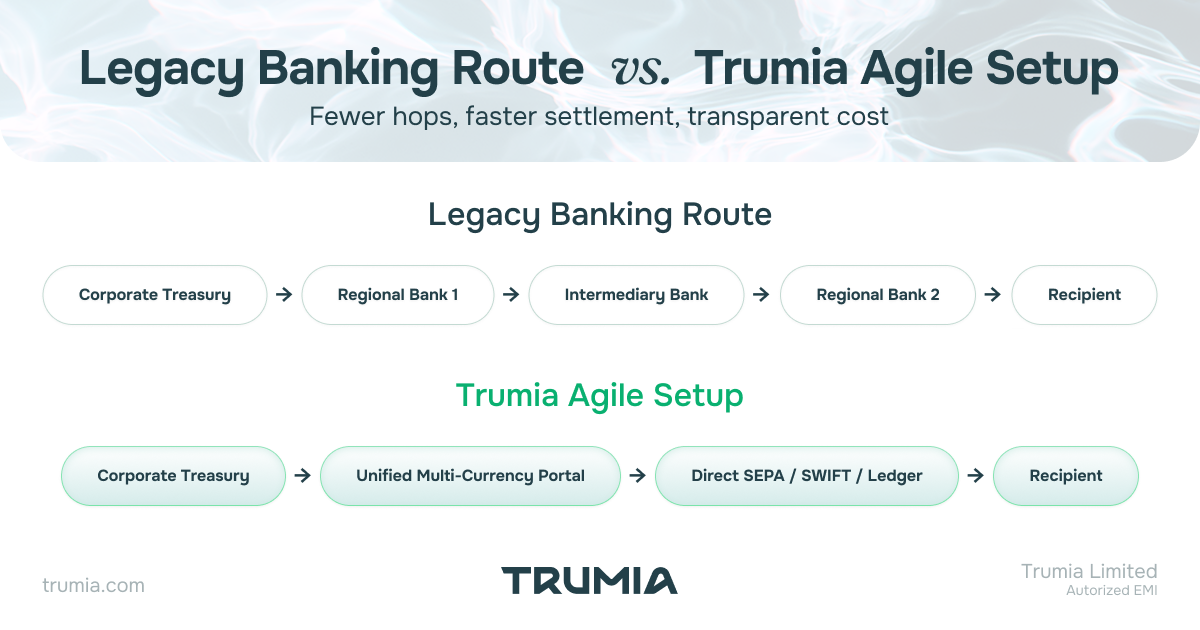
Historically, managing corporate treasury across borders meant dealing with rigid, paper-based onboarding that took three to six months to review a single corporate structure. Traditional setups required setting up local entities in every target country, subjecting transactions to forced foreign exchange conversions, manual batch entry, and clearing delays of three to five business days. When unexpected volume spikes occurred, legacy underwriting algorithms frequently triggered automated account holds, freezing operational capital without warning.
Modern agile accounts replace that legacy friction with a digital-first setup. Enterprise onboarding completes in days through automated verification systems, granting access to dedicated virtual IBANs across 17+ core currencies without local entity requirements. Payout execution connects directly to automated REST APIs and instant clearing rails like SEPA Instant, while dynamic risk scoring and dedicated account management ensure high-volume cash flows move without arbitrary delays.
When a commercial bank delays international transfers or prolongs account setup, the negative impact extends far beyond basic transaction fees. In fast-moving sectors like iGaming, IT services, and global e-commerce, execution speed is critical. Waiting around months for account approval allows competitors to capture market share.
Plus, traditional cross-border transfers move through complex correspondent networks where intermediary banks deduct unpredictable fees mid-transit, apply inflated foreign exchange markups, and charge lifting fees that erode net margins by 2% to 5% annually.
Compounding these financial losses, traditional underwriters rely on legacy risk metrics that routinely misinterpret high-frequency micro-transactions, affiliate payouts, or digital entertainment cash flows as high risk. This results in sudden account holds that freeze operating liquidity right when vendor invoices or player payouts are due.
Managing international corporate capital should support business expansion rather than create administrative friction. Transitioning to an agile EMI infrastructure converts treasury operations into an efficient growth engine.
Modern compliance systems replace physical paperwork with automated registry integration and smart ownership verification, allowing enterprise accounts to complete onboarding in days so businesses can establish operations, collect client funds, and settle vendor invoices without extended underwriting delays.
At the same time, dedicated virtual IBANs enable companies to collect and hold funds in major local currencies (such as EUR, GBP, and USD) without forced conversions, allowing disbursements to suppliers, contractors, and regional partners to be executed directly from existing currency balances.
Processing corporate payouts manually through a basic portal is inefficient for high-volume operations. An agile financial structure integrates internal enterprise software directly with payment rails via REST APIs:
Scaling an international enterprise requires financial infrastructure that adapts to changing market conditions. The traditional corporate banking model (characterized by rigid geographic boundaries, slow manual reviews, and opaque pricing structures) was built for a slower era of commerce. In a global economy driven by real-time transactions, relying on outdated clearing channels introduces unnecessary risk and cost.
An agile corporate account transforms financial management from a passive administrative burden into a strategic operational tool. By uniting multi-currency account infrastructure, direct rail settlement, and automated risk verification within a single regulated framework, modern platforms give finance leaders complete visibility and control over global cash flows.
Choosing the right financial stack means establishing an infrastructure capable of supporting long-term international expansion. Working with an MFSA-regulated Electronic Money Institution allows growing enterprises to reduce operating costs, eliminate clearing bottlenecks, and execute cross-border payouts with certainty.


Address:
Quad Central, Q3 Level 3, Triq
l-Esportaturi, Zone 1, Central Business District, Birkirkara, CBD 1040, Malta
Email Address:
contactus@trumia.com
For Press Inquiries:
press.office@trumia.com

